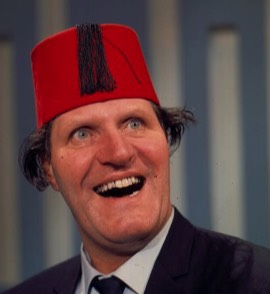
Thomas Frederick Cooper (19 March 1921 – 15 April 1984) was one of the most distinctive and best-loved comedians in British entertainment history. Instantly recognisable by his towering frame, red fez and apparently disastrous magic tricks, Tommy created a comic character entirely his own and became one of the great stars of British variety and television.
Born in Caerphilly, Wales, Tommy was the son of Thomas Cooper and his wife Gertrude. The family moved to Devon while he was still very young, and it was there that much of his childhood was spent. His fascination with magic began early when, at around eight years old, he was given a magic set by an aunt. What began as a childhood interest would eventually form the basis of one of Britain's most famous comedy acts.
Before entering show business, Tommy worked as a shipwright. With the outbreak of the Second World War, he joined the Royal Horse Guards, serving for seven years and spending time with the forces in North Africa. It was during his military service that entertainment began to become more than a hobby. He performed magic and comedy for his fellow servicemen and later became involved with service entertainment organisations.
According to the story that became part of Cooper's legend, while appearing in Cairo he needed a pith helmet for a routine but could not find one. Spotting a waiter wearing a fez, he borrowed it instead. The sight of the enormous Cooper wearing the comparatively small red hat produced such a laugh that he kept it as part of the act. The fez eventually became one of the most instantly recognisable pieces of costume in British comedy.
Following demobilisation, Tommy turned professional. His first important London engagement came in 1947, when musician and agent Miff Ferrie secured him work at the Windermere Club. Ferrie would remain Tommy's agent for the rest of his career, an extraordinary professional partnership lasting almost four decades.
Tommy initially worked the traditional variety circuit, appearing in theatres, clubs and pantomime. In the 1949-50 pantomime season he even appeared as an Ugly Sister in Cinderella. His rise came during the final great years of British variety, when performers learnt their craft night after night in front of live audiences, and an unsuccessful routine could quickly disappear from the act.
What made Cooper unusual was that he was, underneath the carefully constructed chaos, a genuinely accomplished magician. He became a member of The Magic Circle, but instead of presenting magic as polished mystery, he discovered that audiences found him even funnier when the tricks apparently went wrong.
The stumbling, confused magician who seemed surprised by his own props was therefore a character, not simply incompetence. Tommy knew exactly where a trick should succeed, where it should fail and, most importantly, where the laugh should fall. His apparently effortless comedy concealed an extraordinarily disciplined approach to his work.
That discipline can now be seen in the surviving Tommy Cooper Collection at the Victoria and Albert Museum. The archive contains more than 116 boxes of material together with props and posters spanning his career. Particularly fascinating is his enormous personal 'gag file', in which jokes and ideas were meticulously catalogued alphabetically. Behind the image of the hopeless magician was a performer who studied, collected and organised comedy with remarkable care.
Television transformed Tommy from a successful variety performer into a national star.
His early television appearances date back to 1948, and during the following decades he became one of the medium's most familiar faces. Eventually he was given programmes built around his own unique personality and went on to front a succession of successful television series.
The format barely needed explanation. Tommy would walk on wearing his fez, stare at the audience with his wonderfully bewildered expression and begin producing an apparently endless collection of objects, jokes and tricks that either worked, nearly worked or went spectacularly wrong.
His physical presence was crucial. At around six feet four inches tall, with enormous hands and shoulders, he could often create laughter simply by standing on stage. Add the fez, the nervous grin, the occasional muttered observation and his famous delivery of “Just like that”, and Cooper had created one of the most instantly recognisable comic characters of the twentieth century.
Yet his comedy remained closely connected to the traditions of variety. Props, visual gags, one-liners, magic, audience interaction and carefully rehearsed routines could all be transported from a variety theatre to a television studio without losing their appeal.
At the height of his fame Tommy was among Britain's biggest entertainment stars. He performed for the Royal Family, appeared in three Royal Variety Performances, and became one of the country's highest-paid and most frequently impersonated entertainers.
Among fellow magicians he was equally respected. The joke was always that Tommy could not perform magic properly, yet those within the profession understood that the opposite was true. His timing depended upon knowing precisely how a successful trick should look before deliberately upsetting the audience's expectations.
His influence extended far beyond magic. Generations of comedians have admired the simplicity of Cooper's stage character, his ability to create enormous laughs with the smallest gesture and the wonderful impression that everything was happening to him for the first time.
Tommy was also part of another great tradition of British entertainment as a member of the Grand Order of Water Rats.
He was initiated as Water Rat No. 595, and the Order's historic Roll of Honour records:
“Tommy Cooper – Thomas Frederick Cooper. Comedian be-fezzed magician.”
His membership placed him amongst generations of comedians, magicians, musicians and variety performers who have formed the backbone of the Water Rats since the Order's beginnings in 1889.
For an entertainer whose career had been forged in variety theatres, clubs, pantomime and live performance before television brought him into millions of homes, the Water Rats was a particularly natural home.
Tommy continued working throughout his life.
On the evening of 15 April 1984, he appeared on the live ITV variety programme Live from Her Majesty's, broadcast from Her Majesty's Theatre in London. During his act he collapsed on stage after suffering a heart attack.
At first, both the theatre audience and many watching at home believed the collapse to be another Cooper gag. Such was the character he had created that even at that terrible moment an audience instinctively expected Tommy to get back up and produce another laugh.
He died aged 63.
It remains one of the most extraordinary and poignant moments in British television history, but it should never overshadow the enormous career that came before it.
For almost four decades Tommy Cooper had taken the traditions of the magician, the variety comedian and the visual comic and combined them into something completely individual.
His legacy remains remarkably strong. His fez and other material associated with his career have been preserved by institutions including The Magic Circle and the Victoria and Albert Museum, ensuring that the working life of this extraordinary entertainer forms part of Britain's national theatrical history.
Tommy Cooper did something that very few performers ever achieve. He created a character so distinctive that a fez, a raised eyebrow or two simple words are enough to bring him immediately to mind.
Behind that apparently chaotic figure was a dedicated craftsman, an accomplished magician and one of the great students of laughter.
Water Rat No. 595, Tommy Cooper remains not simply one of the great names of the Grand Order of Water Rats, but one of the defining figures of twentieth-century British comedy.
PHOTO GALLERY
ARCHIVE VAULT
MEDIA